

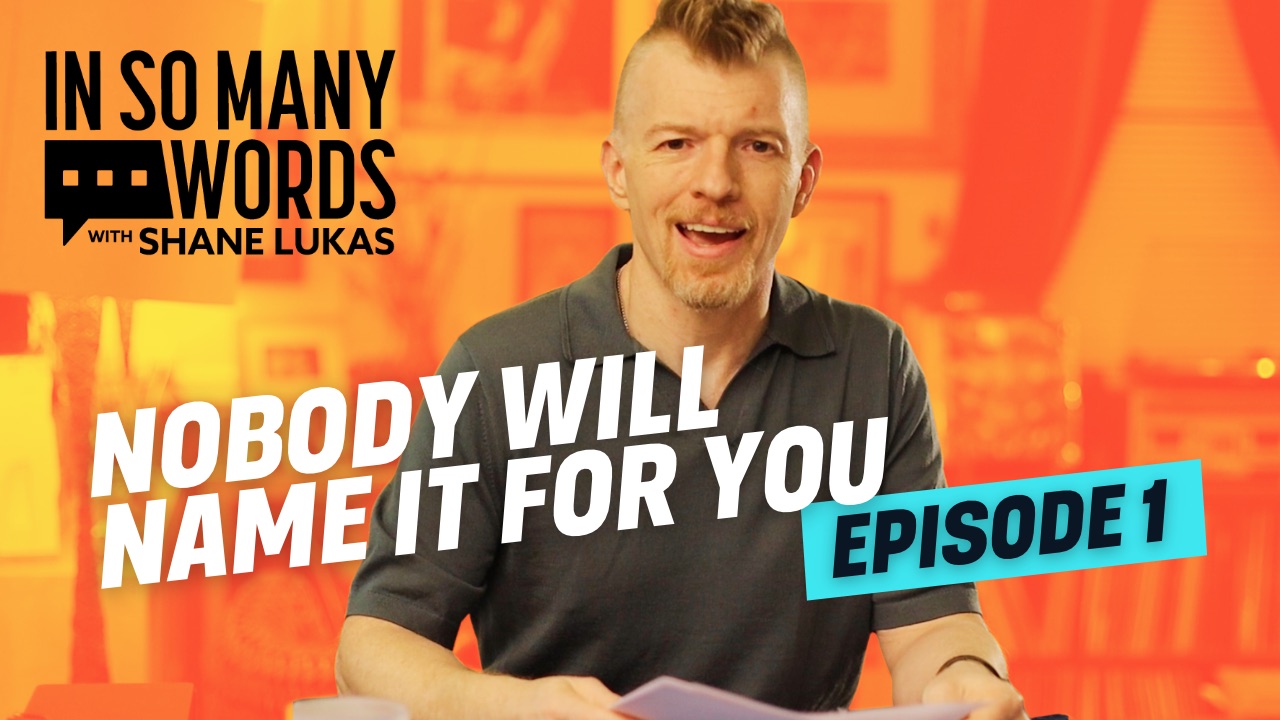
Episode 01 · Monday, Nov 9, 2026 · 13 min
Nobody Will Name It for You
Forty-eight percent of nonprofit CEOs say they have been pressured to reframe how they publicly describe their work. If you run communications, that pressure did not land on their desk. It landed on yours.
The argument
the drift is not the decision. It is the silence after it. Most organizations did decide to change their language, under real pressure, to keep staff safe and the doors open. Almost nobody wrote it down, scheduled a review, or said it out loud — and a year later it is not a decision any more, it is just how you talk.
Show notes
This is the first episode of In So Many Words — a solo podcast about the words our sector uses, and by words I mean the whole brand narrative: what you say, what you show, and what you leave out.
I am not watching this from the outside. I have written that careful sentence myself, more than once, and for money. Some of that language is still standing in an organization today, and I am not sure it should be.
WHAT YOU LEAVE WITH
A five-step method, about forty minutes, and you only do the first three steps once.
1. Find the old language — the Wayback Machine, your last two annual reports, the boilerplate at the bottom of a press release from two years ago. All free.
2. Build two columns — what we said, what we say now, dates on both, no commentary. Three to five changes, not twenty.
3. Pick one — not the most upsetting, the most noticeable. The test is whether a person you serve would notice.
4. Write the sentence — four parts, and it works best when it is boring:
"We used to say X. We now say Y. As far as I can tell that changed around [when]. And I don't think we ever actually discussed it."
5. Say it to one person — not a meeting, not email. Then say nothing else.
No ask. No recommendation. No name in it.
THE THREE ANSWERS YOU WILL GET
"Yes, we decided that." "Did we?" "Now is not the time." What each one actually means, and the follow-up for each — including the question that converts a deferral into a date.
IN THIS EPISODE
Why the communications lead is the only person holding both versions of the language, and almost never the person who was in the room.
Three ways this goes wrong: when it lands as a grievance instead of a fact, when it happens in a group instead of one-to-one, and when it is a proxy for something else.
The one thing not to do — the comparison that turns a question about your own choices into a competition.
The real risk, said plainly. This is not a free move.
SAID IT PLAINLY
Kimberlé Crenshaw, who in 1989 published "Demarginalizing the Intersection of Race and Sex" and gave a name to something a lot of people had lived and nobody had a word for.
THE RESOURCE
The Center for Effective Philanthropy, State of Nonprofits 2026: What Funders Need to Know. Free. 380 nonprofit leaders, surveyed February 2026. Figure 2, page 10, is the one to look at — find your own organization in it.
https://cep.org/report-backpacks/state-of-nonprofits-2026/
NEXT TIME
The decision itself — and the one line that turns a change you cannot challenge into a change you can.
Hard truths for nonprofit and mission-driven communicators. New episodes every other Wednesday.
insomanywordspodcast.com
Produced by A Great Idea. Views are my own. No client of the studio appears in any episode.
Free resource from this episode
The Naming Sentence
Free, no sign-up. Word and PDF.
Download it →Try it on your own org
Take the Language & Exposure Check-up
Twelve questions, five minutes, a scored result.
Start the check-up →Found your org in this one? Let's talk.
Bring the documents. Shane will help you sort out what changed, who decided, and what to say instead.
Book a session with ShaneTranscript
0:00The drift is not the decision
The drift is not the decision. It is the silence after it. And the person who can break that silence is almost always the communications professional who writes the words — and controls the brand.
Somewhere in the last two years your organization started describing itself differently. Not all at once. A word here, a page rewritten, a line taken out of the boilerplate, because someone upstairs or down the hall got a call.
And here's the part I want to sit with. You can probably picture the exact sentence. You might have written it. But if I asked you when the decision was made, and who made it, and what it was supposed to buy — could you tell me?
Most people can't. Not because they're careless or they aren't paying attention, but because nobody ever really said it out loud.
By the end of this you're going to have one sentence written down, one person to say it to, and a way to talk about the change that happened and what next steps to take.
0:53What this show is
This is In So Many Words. Hard truths for nonprofit and mission-driven communicators. I'm Shane Lukas, and I have thirty years under my belt as a creative director, art director and writer — all of that. And I'm so glad to be here.
Here's what the show is, so you can decide in the next couple of minutes whether you want to stay. Every two weeks I'm going to take one argument about the brand, about the language our sector uses, and hand you something you can actually do with it. Twenty minutes. No guests, no panel, no both-sides.
That last part is deliberate, so let me explain why. A panel is how you make a difficult claim survivable — you put it next to three other claims and let the listener pick. I think that's mostly a way of avoiding the real work. If I'm going to ask you to take a position inside your organization, I should be willing to take one out here first.
So I'll be honestI'll probably be wrong sometimes. In public, with my name on it. But that's the trade, because we are working toward systems change. And now we can do that together.
2:06What 380 nonprofit leaders reported
In February of this year the Center for Effective Philanthropy surveyed nonprofit leaders about what they'd been through since January of 2025. Three hundred and eighty of them answered, and I think the answers are going to be pretty resonant for all of us.
Forty-eight percent reported pressure to meaningfully reframe how their work is publicly described. Thirty-seven percent reported legal challenges related to the people or issues their work affects. And thirty-eight percent reported concerns about their staff's or board's well-being and safety.
2:34Fear, not cowardice
So when the language moved, it moved under real pressure. And some of it was the pressure of being genuinely unsafe.
I want to be careful here, because this is where most commentary and most critique about the sector goes wrong. Some of it was fear, but not cowardice. A lot of organizations made the hard call to keep people safe and the doors open. They made difficult decisions with incomplete information and a short clock.
I know that — because I've written that careful sentence myself. More than once. And for money.
3:00Where I did this myself
One example. I think we can all remember the things happening around 2020 — there were a lot of different moments in there. So let me tell you where I learned this from my own experience.
We had an opportunity to respond on behalf of an organization that had been serving communities that were, at that moment, very much in public discussion. We changed that language very quickly, on the fly. And it ended up carrying through other parts of the organization without a real conversation happening.
The challenge is that it didn't reflect some of the commitments the organization had. And I'm not sure all of that language should still be standing today, because it doesn't reflect decisions that the community is seeing.
So there's a drift. And a drift made under pressure is easy to leave in place once the pressure changes.
3:58How a decision becomes the house style
Nobody schedules a review. Nobody's assigned to notice. So the sentences, the brand changes — they just stay. And a year or more later it's not a decision any more. It's just how you talk.
That is the drift. It's not the choice. It's the forgetting that the choice ever happened.
4:26Why it lands on the communications lead
And here's why I hold this for you specifically. If you hold the old boilerplate and the new boilerplate together, the only person in that organization who has a picture of what it says now and what it used to say is the communications person. You're the one responsible for that.
The only person who knows why it changed is probably not even in the room any more. Which is exactly why the naming often has to come from you — and why the questions have to come from you too.
4:49The method: five steps, forty minutes
So here's how you actually do it. Five steps, forty minutes. And you only have to do the first three steps once.
5:06Step one — find the old language
Step one. Find the old language. This takes about fifteen minutes.
Choose three places, and all three I'm going to suggest are free. The Internet Archive — the Wayback Machine, at web.archive.org. Put in your own homepage or your about page and pick a date eighteen months back. If you're trying to go back pre-2020, you can do that too.
Then grab your last two annual reports. And grab the boilerplate at the bottom of any press release from two or more years ago. That's often where you can see the organization really talk about itself, and nobody ever thinks to update it.
Copy and paste those. Don't summarize them. You want their words — the words that are part of the organization — not your memory of them.
5:48Step two — two columns
Step two. Two columns. On a piece of paper, handwritten if you want, otherwise in a document.
Left columnwhat we said. Right column: what we say now. Dates on both. No commentary.
Resist the urge to editorialize, because you're going to show this to someone who may disagree with you, and every adjective you give them is a handle to grab.
You're looking for about three to five changes. If you find twenty, they're probably copy edits. I wouldn't bother with those — keep the ones that are priorities.
6:16Step three — pick one
Step three. Pick one of those. Take a few minutes and really decide.
Not the most upsetting one. The most noticeable one. The test is: would a person you serve notice this change?
If a funder would notice but a client wouldn't, that's a positioning change and it can wait. But if the people you exist for — the people you serve, the communities you walk alongside — would read it and conclude that you are no longer doing the thing, start there.
6:39Step four — write the sentence
Step four. Write the sentence. Four parts, in this order, and it works best when it's boring.
We used to say — and then the old wording, exactly.
We now say — and then the new wording, exactly.
And as far as I can tell, that changed around — and then roughly when.
And I don't think we ever actually discussed it.
That's the whole thing.
Notice what's not in it. There's no ask. There's no recommendation. There's no “I think we should change it back.” There's no name, no department, nobody who did it. We're not looking to blame anyone. That's not the point.
Four statements of fact and one admission of uncertainty: as far as I can tell. That phrase isn't hedging. It's what makes the sentence answerable, because it invites someone to correct you — and someone correcting you at least starts a conversation.
7:37Step five — say it to one person
Which is why step five, no surprise, is: say it to one person. Two minutes.
One person. Not a meeting. A standing one-to-one if you have one, your own manager if you don't. Just don't do it by email — email makes it a document, and a document has to be responded to. Spoken, it's a thing you noticed.
And then the hardest part of this entire plan: say nothing else. Do not fill the silence. Don't soften it. Don't supply the counterargument on their behalf. You've put a fact on the table, and you want to let it sit there.
8:23The three answers you will get
Now you'll get one of three answers. Here's what each one means, and what you can say next.
First“Yes, we decided that.” Good. Great. That's an outcome, and it's more common than you expect. Your follow-up is a question: do you remember what we were responding to? Because now you're not asking about the words, you're asking about the conditions — and conditions can change.
Second“Did we?” That might be the answer you're really looking for, because now you've put something on the table. Your follow-up can be as simple as: would it be worth finding out who did?
Third“Now is really not the time.” Accept that instantly. Don't push. Then ask the only question that converts a deferral into a date: fair — what would need to be true to bring this back up? Write it down and repeat it back. Now you have a condition and the beginnings of a calendar entry, which is more than you had this morning.
9:41The one thing not to do
And the one thing not to do, because it's the most common way this goes wrong: don't run it as a comparison with a peer organization. You don't want to make this a competition, and you don't want to get people defensive.
9:52The resource: CEP State of Nonprofits
I mentioned a resource earlier and I think it's invaluable, so let me share it properly. It's the Center for Effective Philanthropy's State of Nonprofits.
Why it's so goodwe are in an environment that is changing, and this lets you see what around four hundred people who responded say is actually affecting them since January of 2025. It helps you understand the environment you're in — which is critical, because it helps you frame the conversation when you're talking about these changes.
10:28Where the naming fails
So let's talk about where this goes wrong.
You follow the process, you come up with that statement — great. But when the naming fails, here's what has happened. You brought it up and it landed as a grievance instead of a fact. That's why you want it as a fact. Or you didn't bring it up one-to-one, you brought it up in a group, and people got immediately defensive. Or you brought it up as a proxy, and not as the issue you actually wanted to talk about. That one is really important.
11:06The real risk
And let me be realthere's a cost to this. There's a risk. You're bringing up something that might be very sensitive — be clear about that. Know there's some risk going in. But you're doing it for the right reasons.
11:17Said It Plainly: Kimberlé Crenshaw
Before I go on, let me share a little about someone who did this well.
In 1989 a law professor named Kimberlé Crenshaw published a paper called “Demarginalizing the Intersection of Race and Sex.” In it she gave a name to an experience people had lived through and nobody had a word for: what happens when you're discriminated against on not one count, but two. She called it intersectionality.
Whatever you think about where that word has ended up — and it's been through a rough time — what she did matters. She didn't run a campaign. She wrote down a thing that was already happening, precisely, and gave people a word to point at it with.
That's our whole job. You name it, and people can finally argue about it. Which is why the drift is such a risk, and why it's so important to be conscious about the language we use every day.
12:22This week
So that is the show. One argument, one thing you can do, every two weeks.
If you take nothing else from this episode: the drift is not the decision. It is the silence after it. And the person who can break that silence is almost always the communications professional who writes the words — and controls the brand.
This weektwo columns. Pick one example. Four sentences. Talk to one person.
That resource, the CEP report, I'll link in the podcast details.
And next timethe decision itself, and the one line that turns a change you cannot challenge into a change you can.
I'm Shane Lukas, and this is In So Many Words. If you want to be the one who names it — name it. In so many words.